It always happens in the quietest second of the meeting. The recovery matters less than people think — what people remember is whether it kept happening.
Here is the short version of handling it, and the longer version of making sure the next one never fires.
In the moment
- 1Silence it immediately with the side button — do not dig for the app or answer to explain.
- 2Say nothing beyond a short "sorry" if the room has stopped; a long apology extends the interruption you are trying to end.
- 3Mute properly straight away, so the follow-up call does not ring thirty seconds later.
- 4If it was genuinely urgent — a school, a hospital — say so briefly and step out. That is a legitimate reason and people understand it.
The situations worth protecting
- Client meetings and interviews, where the phone ringing shapes the impression of you.
- Lectures, seminars and exams, where it disrupts a whole room.
- Worship, funerals and ceremonies, where the cost is social rather than professional.
- Cinemas, theatres and libraries, where the rule is explicit.
- Shared offices and hospital wards, where a repeat offender becomes known for it.

Preventing the next one with Hush
- 1
Add the meeting rooms you use
Your own office, the client site, the lecture hall — each becomes a quiet place in Hush.
- 2
Get the nudge at the door
Hush reminds you as you arrive, which is the only moment muting is both possible and top of mind.
- 3
Note the specifics
"Vibrate off too — the table amplifies it" is the kind of detail worth writing once.
- 4
Keep the list current
Add new sites as your work moves around; remove the ones you no longer visit.
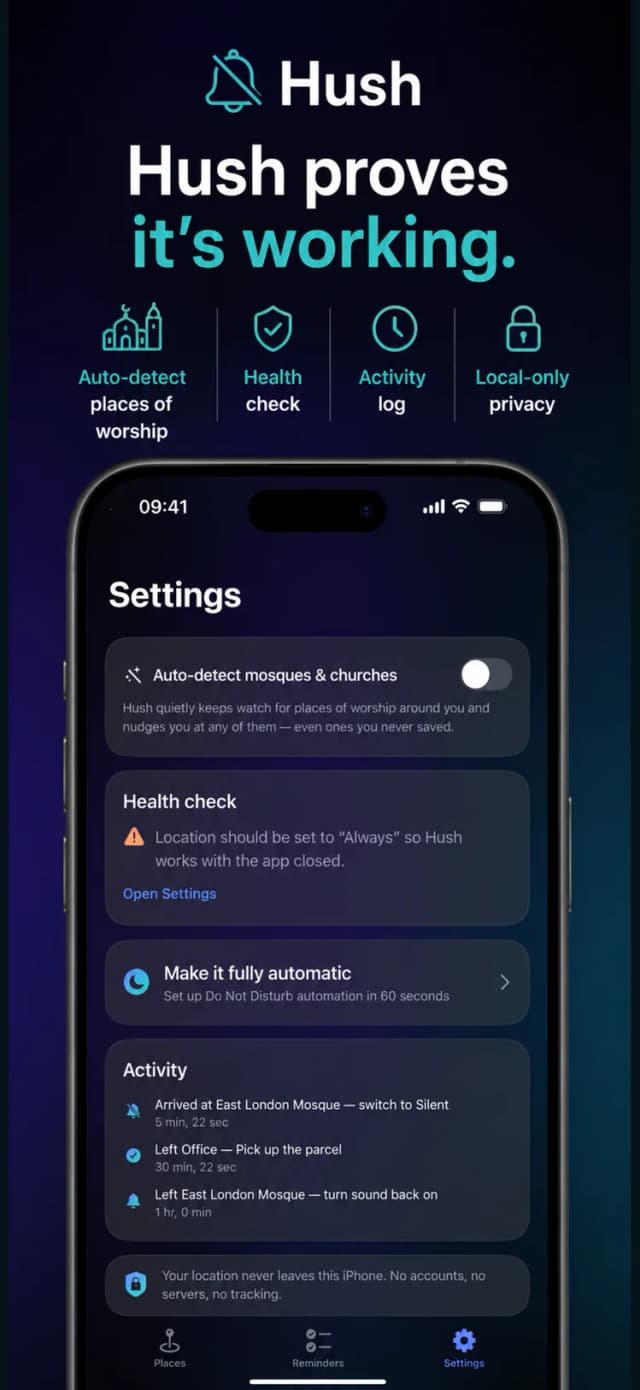

Free to download on iPhone & iPad
Frequently asked questions
Should I just leave my phone on silent permanently?
Many people try, and then miss calls that mattered. Muting where it matters and staying reachable elsewhere is usually the better trade.
Does Hush work for places I visit rarely?
Yes — that is where it helps most. Rare visits are exactly the ones no habit or schedule covers.