Most parents start with the alphabet song and uppercase letters, because that is how we remember learning it. Reading research points somewhere slightly different: children get further, faster, when they learn letter sounds before letter names, and start with the letters that appear most in simple words.
None of this requires a curriculum at home. It requires knowing the order, and doing a little of it often.
The order that works
- 1Sounds before names: "mmm" is more useful for reading than "em". Letter names come along naturally afterwards.
- 2Start with high-frequency, easy-to-blend letters — s, a, t, p, i, n — rather than marching through A to Z.
- 3Blend as soon as you have a few sounds: with s, a and t a child can read "sat". Reading a real word early is enormously motivating.
- 4Add lowercase early. Books are mostly lowercase, but children are usually taught uppercase first.
- 5Bring in tracing alongside sounds — writing a letter reinforces recognising it.
How much practice is enough
- Five to ten minutes a day beats an hour at the weekend — early literacy is built by frequency.
- Stop while the child is still enjoying it. Ending on success is what makes them willing tomorrow.
- Mix modes: hearing a sound, choosing a letter, tracing it, finding it in a book.
- Expect uneven progress. Plateaus of several weeks are completely normal at this age.
What not to worry about
Letter reversals — b and d, p and q — are developmentally normal well into the first years of school and are not a sign of a problem on their own.
Nor is a child who recognises letters but shows no interest in writing them. Fine motor control develops on its own timeline, and forcing pencil work early tends to build resistance rather than skill.

Practising with Little Genius
- 1
Start with the phonics activity
Your child hears a sound and picks the letter — the core skill, practised directly.
- 2
Trace the same letters
Move to tracing straight after, so hearing, seeing and writing reinforce each other.
- 3
Move to word building
Once a handful of sounds are secure, simple words with picture hints turn sounds into reading.
- 4
Keep sessions short
Set a daily time limit so the app stops before your child’s attention does.
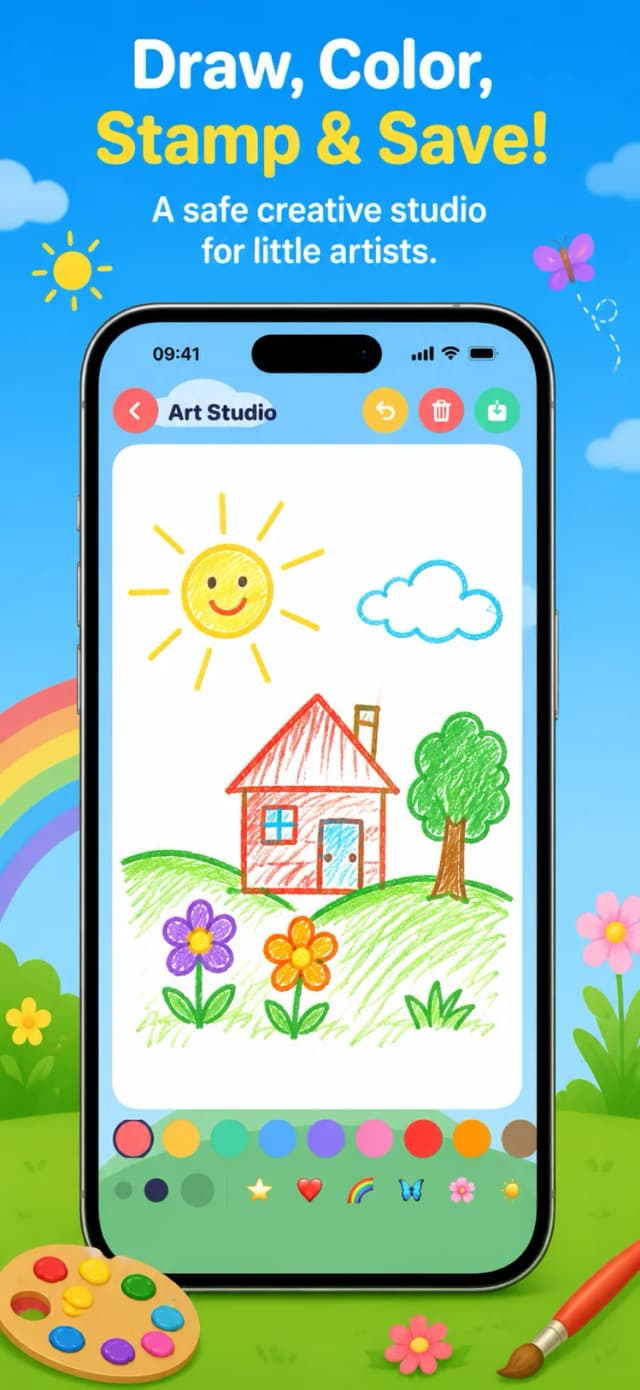

Free to download on iPhone & iPad
Frequently asked questions
What age should a child know the alphabet?
Most children recognise many letters between 4 and 5 and know the full alphabet around 5 to 6. There is a wide normal range, and later recognition is not by itself a concern.
Should I teach uppercase or lowercase first?
Uppercase is easier to distinguish and usually comes first, but introduce lowercase early — almost everything a child will read is lowercase.